Materials and dimensions
3D concrete printing requires a mix that is pumpable, extrudes evenly and is stable enough to carry the following layers. The properties of the dry mix itself do not automatically describe the performance of the finished printed object.
Materials we use
Weber ESL
According to the manufacturer's description, Weber ESL is a pumpable, low-shrinkage, fibre-reinforced grouting mortar for filling vertical and horizontal joints between concrete elements. The published key data are strength class C30/37-4, aggregate size 0-4 mm, density approximately 2100 kg/m3 and fire resistance class A1. The manufacturer states the product is frost-resistant for up to 100 cycles.
Limit of use: Weber ESL is not defined on the manufacturer's product sheet as a dedicated 3D printing mortar. When Print Betoon uses it in the printing process, a suitable mixing, pumping, printing and curing regime is determined separately, and the manufacturer's declarations for jointing applications are not automatically transferred to the finished printed object.
Weber 3D 145-2
Weber 3D 145-2 is a factory-made dry mortar developed for 3D concrete printing. Published technical studies describe it as a C35/45 class mix with a maximum aggregate size of 1 mm, a density of approximately 2200 kg/m3 and a 28-day compressive strength of over 45 MPa. The mix contains Portland cement, mineral fillers, admixtures and a small amount of polypropylene fibres.
Limit of use: Printed material is layered and its properties may depend on the direction of loading, interlayer bond, water content, waiting time and curing. A strength class or laboratory test result must not be treated as proof of the load-bearing capacity of a specific object without a design and, where necessary, testing.
Other mixes are only used after their pumpability and printability have been assessed. For a new material or a demanding application, a test print, test specimen or independent laboratory test may be required.
Dimensions and tolerances
Colour and surface finish
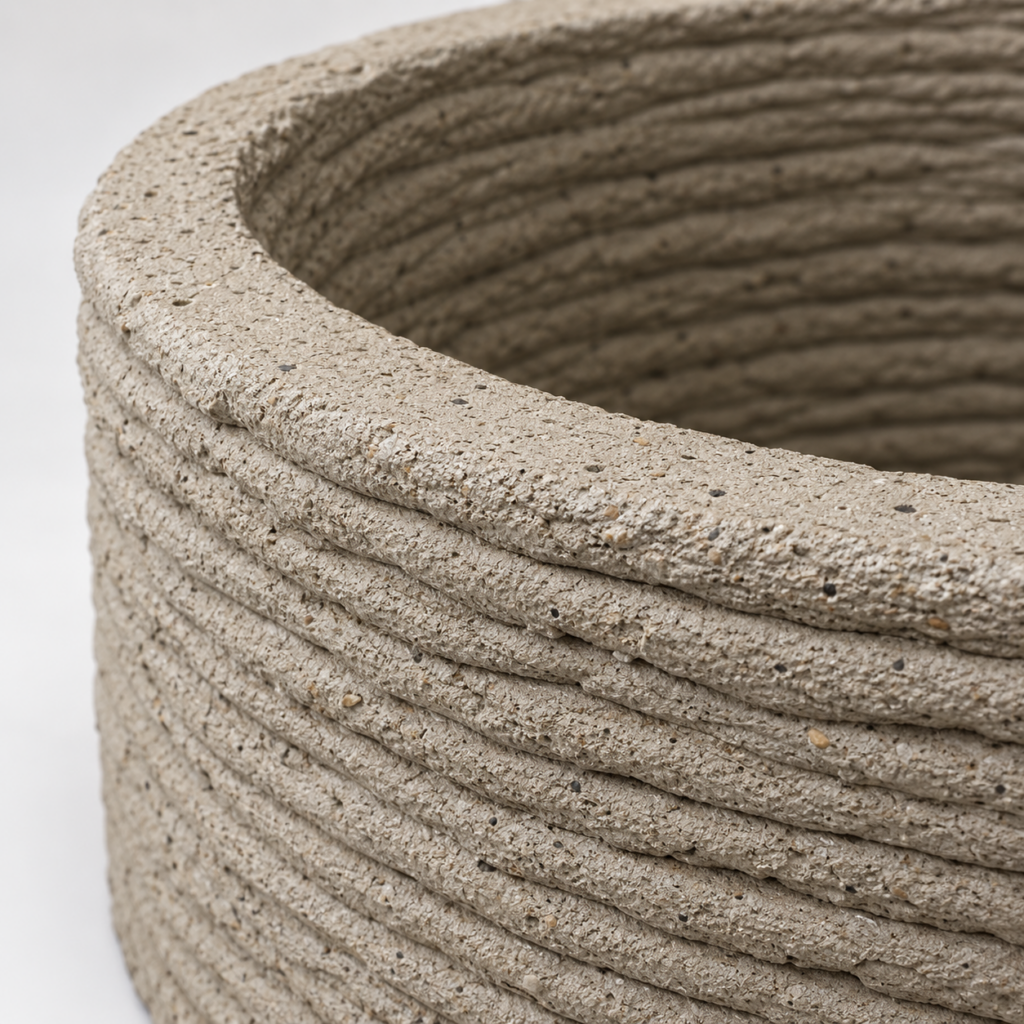
The base colour of the material is cement grey. Raw material batches, water content, temperature, drying, curing and surface protection can cause variations in shade. An exact colour or identical appearance between batches can only be guaranteed on the basis of a separately approved sample and agreement.
The natural surface has visible horizontal layers. Depending on the project, the surface can be brushed, locally smoothed, sanded or treated with a protective product. The suitability of the finish and the maintenance requirements are confirmed before production.
Requirements of the place of use
Outdoor use, freezing, salts, persistent moisture, soil pressure, water retention, heat, food contact and other special conditions must be specified separately in the brief. An environmental class or frost test stated on a material's product sheet does not in itself prove that the entire printed object is suitable for a specific use.
Load-bearing, safety-critical or standard-compliant elements are only produced on the basis of a separate design, an agreed allocation of responsibilities and the required tests.